I study international security providers, including UN peacekeeping operations and private military contractors such as the Wagner Group, with a focus on violence against civilians.
▾
Violence as a Condition: Structure, Composition, and the Use of Lethal Force
Requested by the U.S. Congressional Research Service for distribution
AbstractSince 2014, Russia's Wagner Group has expanded from driving Russian foreign policy across Africa and the Middle East into an integral part of the 2022 invasion of Ukraine. We first draw on the one-sided violence (OSV) literature to show how organizational incentives explain Wagner's violence against civilians pre-November 2021. Despite the static context of those incentives, Wagner's OSV lethality increased dramatically after the invasion. Introducing pre-combat experience (PCE) as an explanatory factor, we provide novel theoretical logic and empirical evidence for how individual-level experience aggregates to unit-level violence.
▾
Here Today, Gone Tomorrow: Dynamics of Peacekeeper Entry and Exit on Violence Against Civilians
AbstractFollowing the 2001 assassination of President Kabila, the UN deployed a peacekeeping mission to the DRC to quell violence against civilians, with mixed results. Using fine-grained subnational data, we examine how the geographic distribution of violence changed before, during, and after peacekeeper deployment, and how withdrawal reshaped local violence and its spread across borders.
▾
More Than Presence: Gendered Dynamics of Interpreting and Negotiating Trust
A chapter in the Oxford Handbook of Interpreting UN Peacekeeping, edited by Vanessa Newby and Chiara Ruffa (Oxford University Press, forthcoming 2027).
▾
Women, Peace, and Participation
A chapter in the Handbook on Gender and Development: Critical Engagements with Gender and Social Justice, edited by Rao, Gideon, Theuerkauf, and Philip (Palgrave Macmillan, forthcoming 2027).
▾
What's in a Name? Implications of Overusing 'Sub-Saharan Africa'
Draft available upon request.
▾
Who Keeps the Peace? Gendered Effects in UN Peacekeeping
ISA Midwest Lynne Rienner Award ISA IO Section Finkelstein Prize (Special Mention)
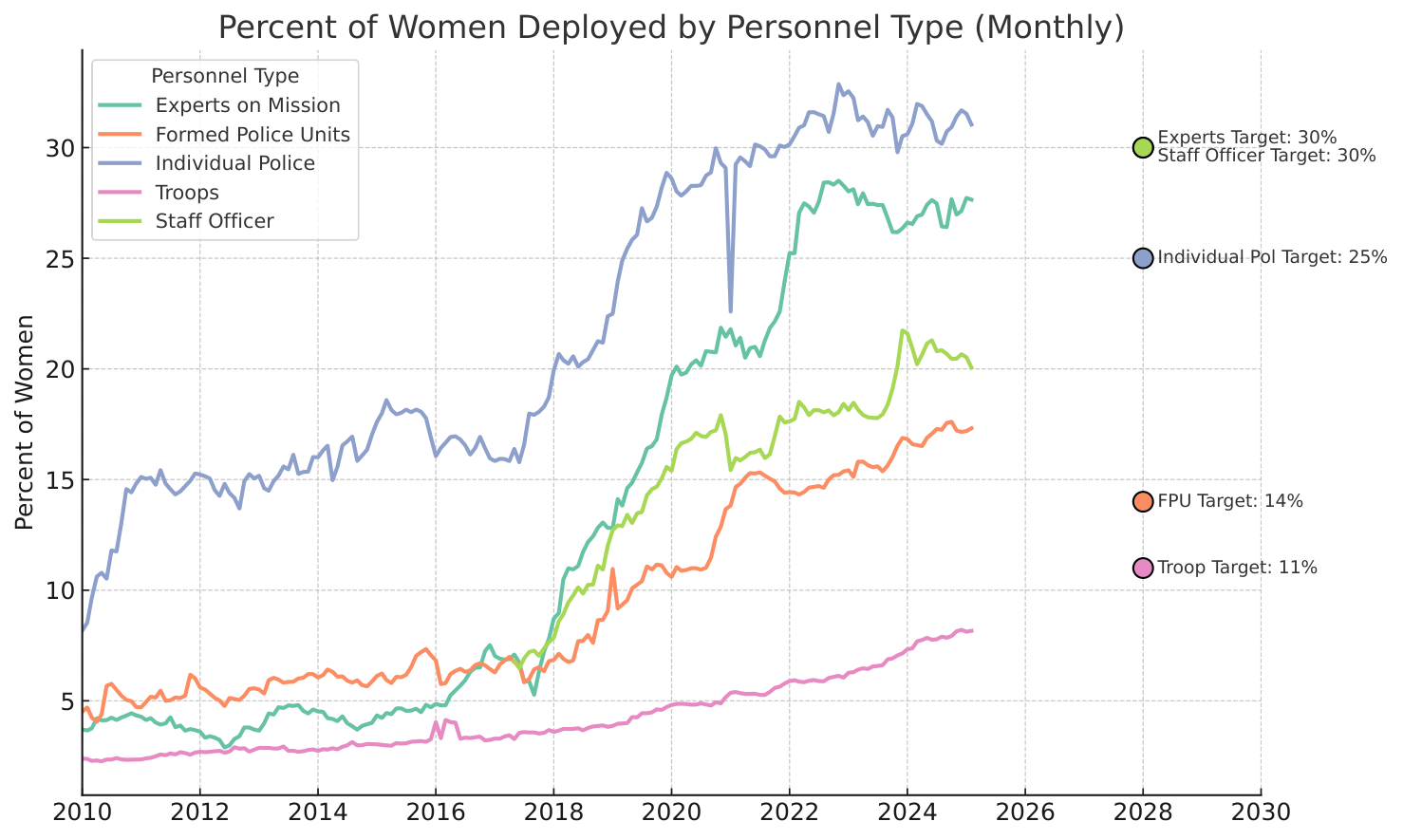
AbstractWhy are some peacekeepers more effective than others? Most analyses of peacekeeper effectiveness fail to account for gendered effects, while work on gender in peacekeeping hasn't taken advantage of recent advances in data. By unifying the literature on female peacekeepers and trust, this paper provides the first comprehensive framework explaining how women enhance UN peacekeeper effectiveness. Using two-way fixed-effects models and optimal matching, I provide the first quantitative empirical evidence that including more women in a force can dramatically increase its effectiveness against rebel one-sided violence.
▾
All About that Base... No Trouble. The Gravity of Peacekeeping Bases
Current draft and replication materials available below.
▾
Double Delegation: The UN Private Security Contractor Database
AbstractPrincipal-agent scholars rarely go past the second level on the delegation chain, especially for delegation from international organizations to private security contractors (PSCs). I argue that delegating authority a second time to PSCs operating outside the direct control of IOs like the UN harms UN authority derived from local actors while increasing state delegation costs. I build the concept of double delegation and assemble a descriptive database of PSC use in UN missions.
▾
Beyond Negative Peace: Do UN Peacekeepers Decrease Security and Trust Concerns?
Available upon request.
▾
Alexander or Ozymandias? Russia's PMC-Driven Foreign Policy in Africa
Available upon request.